
Massachusetts Solar Incentives: Tax Credits, SMART Program & Savings
Massachusetts offers some of the strongest solar incentives in the country. Between the SMART program, net metering, and state-level exemptions, most homeowners can reduce the cost of going solar by 40% or more.
Last Updated: April 2026
Massachusetts gives solar homeowners a stronger stack of incentives than most states. Instead of relying on one big perk, the state combines ongoing performance payments through SMART, bill savings through net metering, a state income tax credit, and sales and property tax breaks. When those pieces line up, the economics can look a lot better than the sticker price first suggests.
For homeowners trying to make sense of it all, the key is knowing that these programs do different jobs. SMART rewards solar production, net metering helps reduce your electric bill, the state tax credit lowers what you owe on your Massachusetts return, and the tax exemptions help keep the project from getting more expensive at purchase and after installation. That layered setup is a big reason Massachusetts stays near the top of the conversation when people talk about solar-friendly states.
What Solar Incentives Are Available in Massachusetts?
Massachusetts homeowners will usually hear the same five incentives come up over and over: the SMART 3.0 program, net metering, the state income tax credit, the sales tax exemption, and the property tax exemption. Each one works differently, and not every solar customer will use every program in exactly the same way, but together they form the core of the state’s solar incentive structure.
SMART 3.0 Program
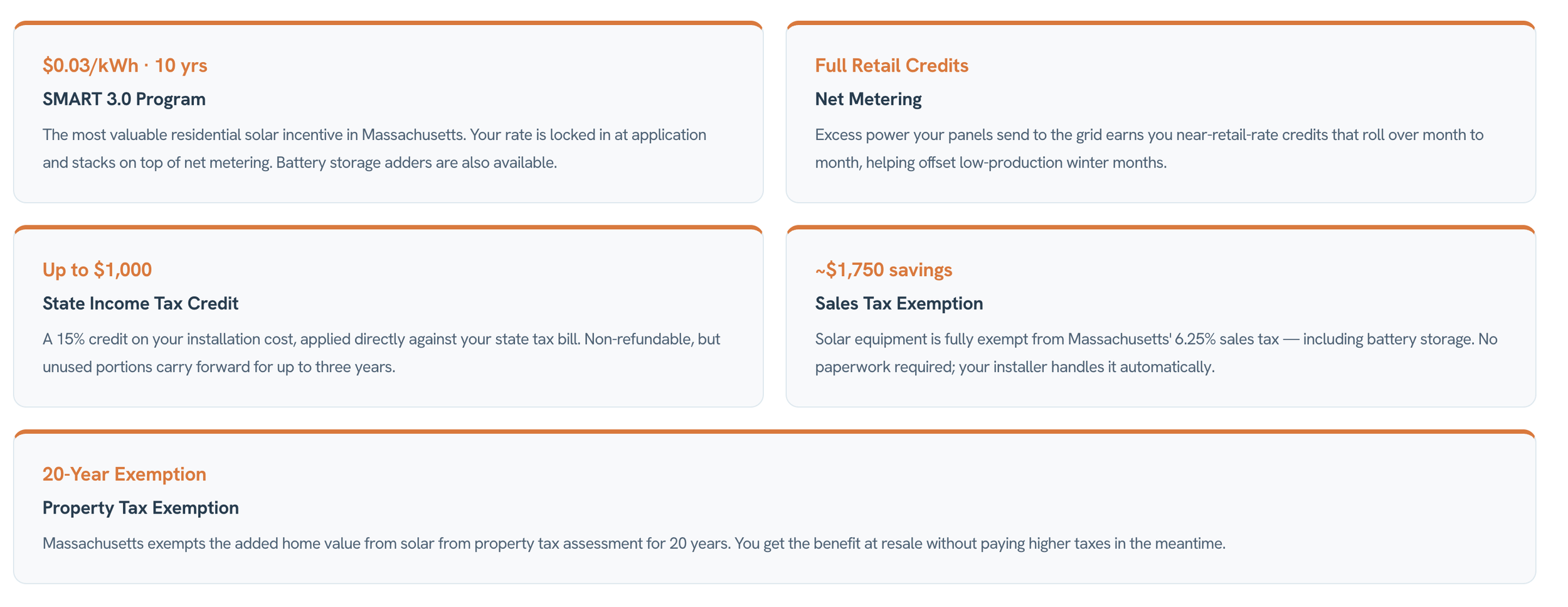
SMART, short for Solar Massachusetts Renewable Target, is the state’s long-term solar incentive program. The current version, often referred to as SMART 3.0, is designed to support solar growth across Massachusetts under the current regulatory framework.
This is a production-based incentive, meaning the value is tied to how much electricity your system generates. It is not based solely on installing panels. Payments vary depending on factors like your approved rate, system type, and how much energy your system produces each month.
Because of that, two homes with solar can see different results even if the systems look similar on paper. SMART adds value over time as your system produces energy, rather than reducing the cost upfront.
Net Metering
Net metering allows solar homeowners to send excess electricity back to the grid and receive credits on their electric bill. It’s a key part of how solar systems translate into real monthly savings.
Solar production doesn’t always line up with household usage. A system may generate more electricity than needed during the day and less at night. Net metering helps balance that by converting extra daytime production into credits that offset future energy use.
Massachusetts uses a cap system for certain projects. Smaller residential systems are often exempt from parts of that process, while larger systems may need additional approvals. The availability of net metering is broad, but project size and setup can affect how it applies.
State Income Tax Credit
Massachusetts offers a state residential energy credit for qualifying solar installations. The credit equals 15% of the net expenditure, up to a maximum of $1,000, for systems installed on a primary residence in the state.
This credit reduces your Massachusetts income tax liability rather than impacting your utility bill. It applies only to qualifying properties and is capped, so the benefit is limited but still meaningful for many homeowners.
Sales Tax Exemption
Massachusetts exempts certain solar equipment from sales and use tax when it is installed as a primary or supplemental energy source in a principal residence.
This exemption happens at the time of purchase, reducing the upfront cost by avoiding the state’s 6.25 percent sales tax. Depending on the size of the system, that can translate to noticeable savings before installation even begins.
Property Tax Exemption
Massachusetts generally provides a property tax exemption for qualifying solar energy systems. Current guidance outlines a standard exemption period of 20 years, with the possibility of longer terms in some cases.
Solar installations can increase a home’s value, but this exemption is designed to prevent that added value from immediately increasing property taxes. During the exemption period, homeowners can benefit from the system without seeing a corresponding rise in their local tax bill.
How Do the Massachusetts Solar Incentives Work Together?
The Massachusetts solar incentive system is best understood as a mix of upfront savings, tax benefits, and ongoing value. The sales tax exemption reduces the cost at purchase, the state income tax credit shows up when you file your taxes, and SMART along with net metering provide value after the system is up and running.
This layered approach is also why solar proposals in Massachusetts can feel a bit complex at first glance. Some benefits reduce the initial cost, others appear later through your tax return, and others build over time through energy production and bill credits. Each incentive serves a different purpose, and they work alongside each other rather than overlapping.
Find out exactly what you qualify for.
Get a free, no-obligation quote that shows your estimated incentives, savings, and payback period - specific to your home and energy usage.
Do Solar Incentives Expire in Massachusetts?
Some Massachusetts solar incentives are written into state law, while others operate through active program structures that can change over time. The residential energy credit and the sales tax exemption are grounded in Massachusetts law, and the property tax exemption also has a statutory framework. SMART, by contrast, is a live incentive program administered under current regulations and program rules.
So the honest answer is not a simple yes or no. The state tax-based incentives do not appear in the current sources as temporary offers with a published short-term expiration date, but program details can always be changed by lawmakers or regulators. SMART is current and active now, yet its rates, block structure, and program administration are the kinds of things homeowners should treat as time-sensitive.
That is why timing matters. Even in a solar-friendly state, the exact value of a project can depend on when you apply, what utility territory you are in, and what program rules are in place when the system is approved and interconnected.
Who Qualifies for Solar Incentives in Massachusetts?
Most Massachusetts homeowners who install a grid-tied residential solar system will qualify for the majority of available incentives. Each program has its own eligibility requirements, but the core qualifying factors are straightforward.
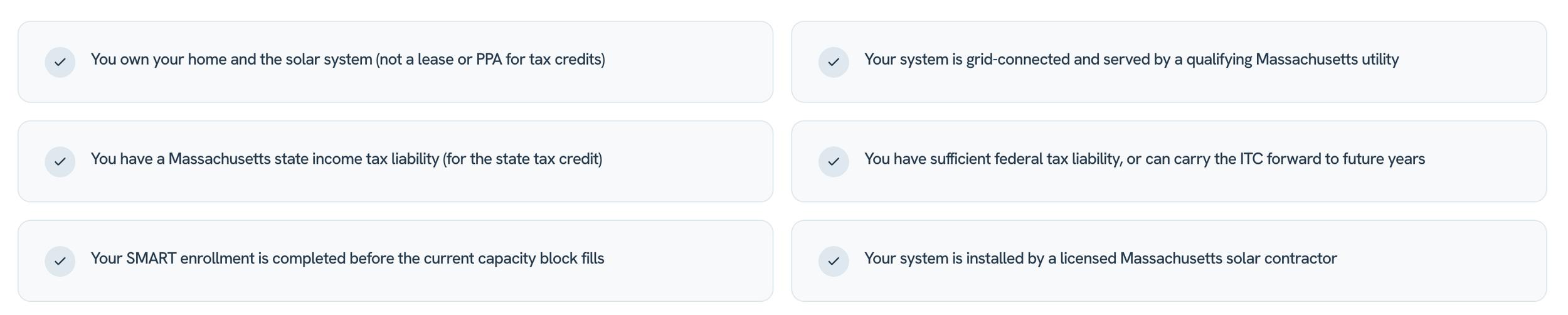
If you lease your solar panels or use a power purchase agreement (PPA), the tax credits typically go to the installer or financing company rather than to you. Homeowners who own their systems outright or finance through a solar loan retain full access to all tax credits and incentives.
How Incentives Impact the Cost of Solar in Massachusetts
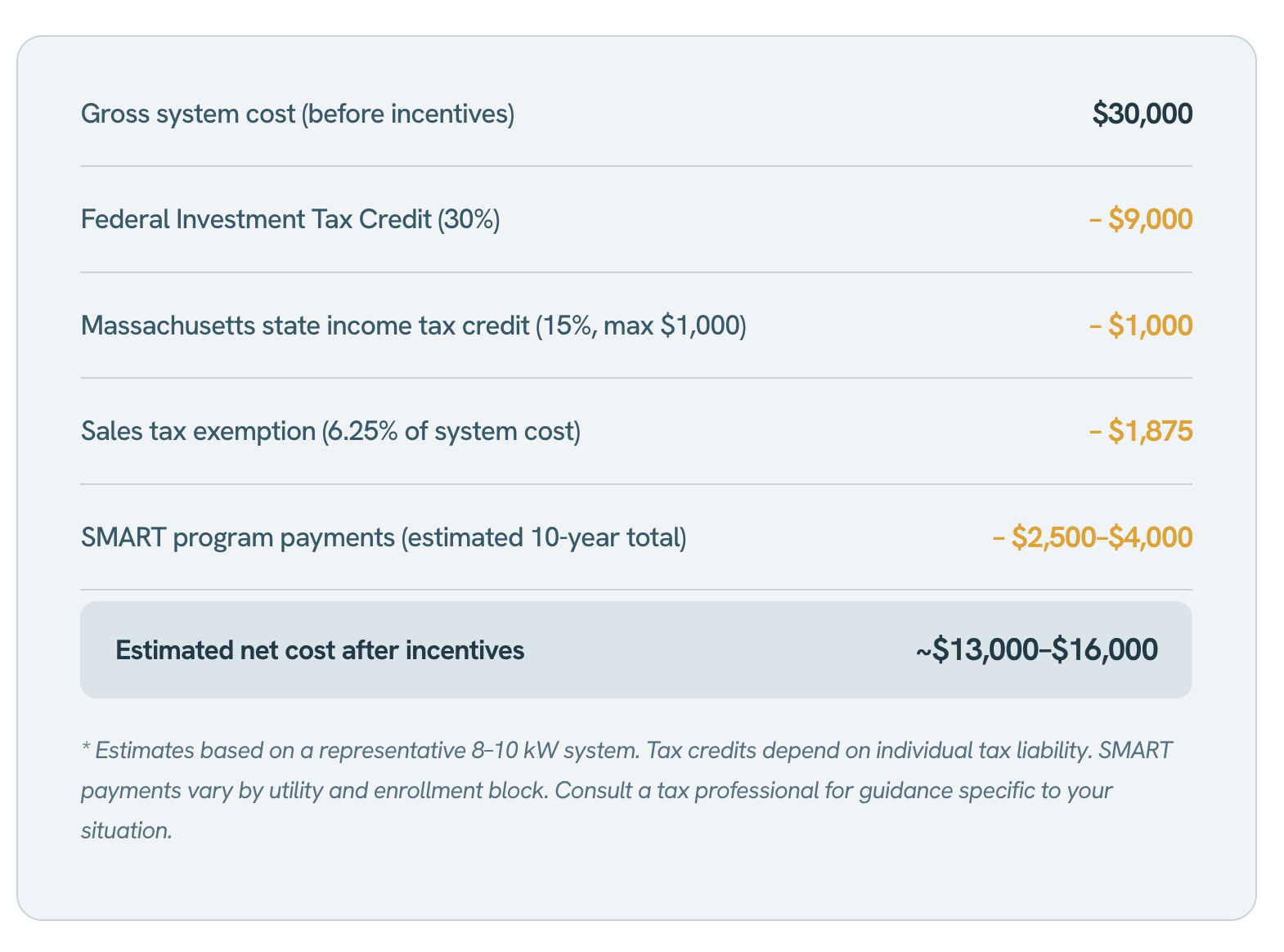
Solar pricing conversations can get muddy because people often focus only on the installation quote. In Massachusetts, that misses the real picture. The state income tax credit can reduce what you owe at tax time, the sales tax exemption lowers the purchase cost of going solar in Massachusetts by avoiding sales tax on qualifying equipment, and the property tax exemption helps prevent future tax drag from the home’s added solar value.
Then there are the operational savings. Net metering can shrink the electric bill by turning excess generation into credits, and SMART adds another layer of value tied to system production. Over time, those ongoing benefits can matter just as much as the upfront tax treatment.
That does not mean every Massachusetts homeowner will see the same return. Roof shape, shading, household energy use, financing terms, utility territory, and final program approvals all influence the math. But incentives are a major reason the all-in economics of solar in Massachusetts can look far better than the raw quote alone.
FAQs About Massachusetts Solar Incentives
What solar incentives are available in Massachusetts in 2026?
Massachusetts homeowners may be able to use several solar incentives, including the SMART 3.0 program, net metering, Massachusetts state income tax credit, sales tax exemption, and property tax exemption. Eligibility depends on system ownership, utility territory, tax liability, system design, and current program rules.
How does the SMART program work in Massachusetts?
The SMART program is a production-based solar incentive in Massachusetts. Eligible solar owners can receive payments based on how much electricity their system generates. The exact value depends on utility territory, approved rate, system size, program rules, and whether any adders apply, such as battery storage.
Does Massachusetts still have net metering for solar?
Yes. Massachusetts still has net metering for eligible solar customers. Net metering allows homeowners to receive bill credits when their solar panels send excess electricity back to the grid. The exact process can vary by utility, system size, and interconnection requirements.
What is the Massachusetts solar tax credit?
The Massachusetts residential solar tax credit is a state income tax credit for qualifying solar installations on a primary residence. It is worth 15% of eligible system costs, up to a maximum of $1,000. The credit reduces state income tax liability and may depend on ownership and eligibility requirements.
Do you have to own your solar panels to qualify for incentives?
It depends on the incentive. Homeowners usually need to own the system to receive certain incentives directly. If you lease your panels or use a power purchase agreement, the installer or third-party owner may receive some incentive benefits instead. Always ask who receives each incentive before signing a solar agreement.
Are solar incentives the same across all Massachusetts utility companies?
Not exactly. Core programs may be statewide, but SMART rates, net metering details, interconnection timelines, and utility approval processes can vary by provider. Two similar homes in different utility territories may see different financial results because of program rules and utility-specific requirements.
Do solar panels raise property taxes in Massachusetts?
Qualifying solar systems may be eligible for a Massachusetts property tax exemption. This can help prevent the added home value from solar from increasing the homeowner’s property tax bill during the exemption period. Eligibility and application details can depend on local rules and system qualifications.
When do Massachusetts solar incentives expire?
Some Massachusetts solar incentives are based on state law, while others operate through active programs that can change. SMART rates, capacity blocks, and utility rules may change over time. Homeowners should confirm current incentive availability before signing a contract or relying on a savings estimate.
Can Massachusetts solar incentives be combined?
Yes, many Massachusetts solar incentives can work together. A homeowner may benefit from state tax credits, sales tax savings, net metering credits, property tax protection, and SMART payments. The exact combination depends on eligibility, system ownership, tax liability, utility territory, and program approval.
See What Solar Could Save You in Massachusetts
Get a custom quote based on your home, your usage, and your goals. No pressure, no obligation.